<?xml version="1.0" encoding="utf-8"?>
<feed xmlns="http://www.w3.org/2005/Atom">

  <title><![CDATA[Acko.net]]></title>
  <link href="https://acko.net/atom.xml" rel="self"/>
  <link href="https://acko.net/"/>
  <updated>2026-03-05T12:10:39+01:00</updated>
  <id>https://acko.net</id>
  <author>
    <name><![CDATA[Steven Wittens]]></name>
    
  </author>

  
  <entry>
    <title type="html"><![CDATA[On Sperging Out]]></title>
    <link href="https://acko.net/blog/on-sperging-out/"/>
    <updated>2021-03-27T00:00:00+01:00</updated>
    <id>https://acko.net/blog/on-sperging-out</id>
    <content type="html"><![CDATA[<p><img src="https://acko.net/files/sprg/cover.jpg" style="position: absolute; left: -5000px; top: 0;" alt="Cover Image" /></p>

<div class="g8 i2 first"><div class="pad">

<h2 class="sub">The Boy Who Cried Leopard</h2>

<p>Recently there's been a new dust up about Richard Stallman and the Free Software Foundation. For those of you just tuning in: an <a href="https://rms-open-letter.github.io" target="_blank">open letter</a> demands that the entire board of the Free-as-in-speech Software Foundation resign, because of past statements and opinions by the radical inventor of free-as-in-speech&nbsp;software.</p>

<p>It's pushed on social media, by various People of Clout. People start sharing their own stories which are somehow meant to prove the power grab is justified because Stallman is horrible. There's also a <a href="https://rms-support-letter.github.io" target="_blank">counter letter</a>, which I and many others have signed. It's all very&nbsp;productive.</p>

<p>The whole situation is remarkable to me. The undersigned claim to detest Stallman, for being an uncompromising libertarian who holds unsavory and immoral views—or at least a caricature of them. Yet they seem incredibly invested in taking over an organization he founded to explicitly defend his personal ideals. You'd think people who are so into guilt by association would prefer to not be associated with any of&nbsp;it.</p>

<p>It's even more remarkable when you notice the backdrop for the <a href="https://selamjie.medium.com/remove-richard-stallman-fec6ec210794" target="_blank">previous dust&nbsp;up</a> involving Stallman: MIT and Jeffrey Epstein. Cos what it looked like to me was that a bunch of people suddenly all had their hands in a very dubious funding cookie jar. At the same time, they decided it was very important to use someone as a scapegoat to pin evil opinions on about sex and consent. You gotta&nbsp;wonder.</p>

<p>What I really want to talk about though is a pattern of behavior that keeps&nbsp;recurring.</p>

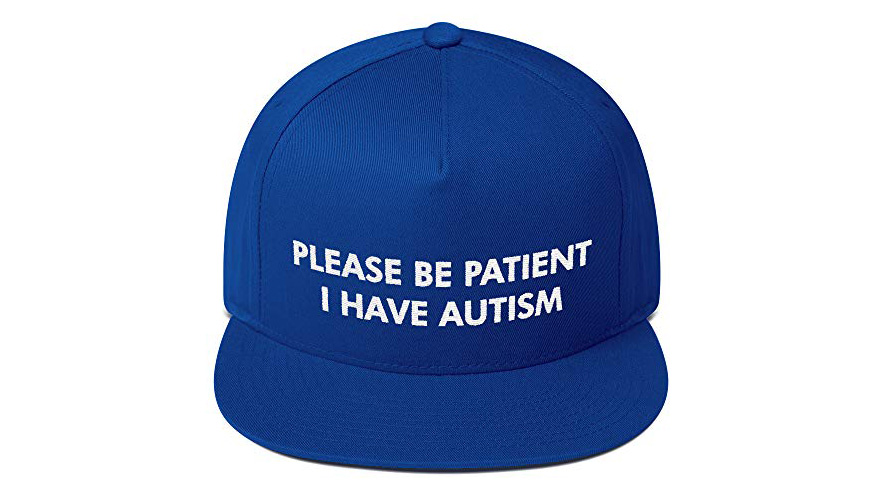
<p class="mt2 mb2"><img class="auto" src="https://acko.net/files/sprg/blue-hat.jpg" alt="Please be patient I have autism - Blue hat" /></p>

<h2>GNU/Plane</h2>

<p>Consider <a href="https://twitter.com/mattblaze/status/1374460079798292487" target="_blank">this story</a>.</p>

<p>T. Tweeter describes the pain of being sat next to Stallman on a grounded plane for 90 minutes. Stallman complains to the flight attendant and becomes irate. Eventually the narrator <em>"takes one for the team"</em> by striking up a conversation with him, lest the entire flight is cancelled, after ignoring him for 45 minutes. Very empathetic. Stallman sees this as an opportunity to criticize his choice of headphones, that they are a symbol of digital&nbsp;oppression.</p>

<p>The intended take-away, I assume, is that Stallman is immature and lacks the social graces to deal with a difficult situation. He takes out his stress on the people around him, who can't do anything about it, making it worse for everyone. He is single-mindedly focused on his own&nbsp;interests.</p>

<p>That doesn't sound very&nbsp;pleasant.</p>

<p>Though as someone on the spectrum, I can read this situation quite&nbsp;differently.</p>

<p>Planes are uncomfortable for anyone: you are stuck in a tin can, in an uncomfortable seat, next to people you can't get away from. For autists, this is extra bad: they often have difficulty tuning out their environment. This can be experienced as an actual assault of painful sounds, smells and so on. Spending several hours on a plane is Nightmare mode for some of us, and noise-cancelling can be a life&nbsp;saver.</p>

<p>The fact that the plane was grounded is also extremely pertinent: autism is often paired with OCD, and a grounded plane represents a schedule that was made but then disrupted. An expectation was set of orderly events, and then this expectation was violated, with no definite end in sight. This can be unbearable for those with a certain&nbsp;predisposition.</p>

<p>The combination of the two is extra bad, because the way autists generally deal with stressful situations is through planning and preparation: they anticipate the various obstacles and harms they might encounter, and preventatively try to mitigate them. If things go wrong despite all this, because of the actions of others, this can register as negligent and rude. The person on the spectrum is trying their best to avoid harm, to avoid foreseeable problems that will result in pain, but their efforts are in vain or actively&nbsp;frustrated.</p>

<p>Worse, if they complain, they will be seen as arrogant and entitled, because what was plainly obvious to them is rarely understood by others. It puts them in a damned-if-you-do, damned-if-you-don't situation. Annoy people by pointing out their mistakes, or stay silent and be forced to live painfully through their slow, unfolding consequences. Ripping off the band-aid is sometimes necessary, and can have remarkable&nbsp;results.</p>

<p>I'm not defending Stallman's behavior, I'm just explaining what it likely looked like from the other side. The part about the headphones is also pertinent, because to someone like Stallman, being able to talk about his interests is, by definition, a <em>good time</em>. It comes from an inability to understand that others have fundamentally different priorities of what is enjoyable. He sincerely believes the person is making a bad choice because he foresees that some technological limitation will eventually deny them a fundamental expressive&nbsp;right.</p>

<p>What is most remarkable is that Stallman's detractors consider themselves exquisitely empathetic. Yet they seem unable to grasp this from his perspective, even if they find it unreasonable. They assume he is being willfully unbearable in a bearable situation, rather than simply having an unbearable experience, as valid or invalid as&nbsp;theirs.</p>

</div></div>

<div class="g10 i1 mt0 mb1">

<p class="mb0"><img class="auto" src="https://acko.net/files/sprg/izakaya.jpg" alt="Japanese Tapas aka Izakaya" /></p>

</div>

<div class="g8 i2"><div class="pad">

<h2 class="mt3">The Izakaya Clown Car</h2>

<p>I have my own story that hits similar notes. At a local conference, I booked a dinner reservation for a group. Because of an error by the restaurant, it almost fell through, but we managed to sort it all out with a different location. It was all very&nbsp;chaotic.</p>

<p>My invitation was very clear: there are no extra seats available. The guest list was locked in. This was an extremely popular place. So you can imagine how I felt when, day of, more people show up than&nbsp;agreed.</p>

<p><em>"Well, there's a few people here with their spouse... we couldn't just tell them not to&nbsp;come."</em></p>

<p>Here's how my sperg brain answered&nbsp;that:</p>

<p><em>"Yes you can. In fact, those are exactly the people who can go off have dinner on their own without being&nbsp;alone."</em></p>

<p>Most people don't want to be the one to say "no, you can't come," even if there is a perfectly good reason for it. I am not that&nbsp;guy.</p>

<p>You see, I know conferences. I know the pattern of wandering in the vicinity of the event as part of a hungry group. The chances of finding dinner any time soon shrink with every new person who tags along. This is the exact thing my dinner plans were meant to avoid. Sorry, that's just how it is. Don't blame me for knowing you better than you do. Bystander group dynamics are predictable and&nbsp;<em>tedious</em>.</p>

<p>We ended up squished around too small a table, with visibly exasperated staff, in a place that until then I had been a regular and welcomed customer at. At a location that normally didn't even do reservations but had been forced to accept out of a Japanese sense of franchise honor. And me a nervous wreck for about the first half of it, at least until the sake kicked&nbsp;in.</p>

<p>I'm sure some thought I was the asshole, too spergy to just "have a good time". This is the problem with people: if the assholishness is sufficiently distributed, everyone can claim individually it's not a big deal, even when all the crap flows downhill towards one person. Out of sight, out of&nbsp;mind.</p>

<p>That dinner ended up getting paid for with a Google credit card, btw. I suspect there's a lesson about valley privilege in there. Just&nbsp;saying.</p>

</div></div>

<div class="g10 i1 mt1 mb0">

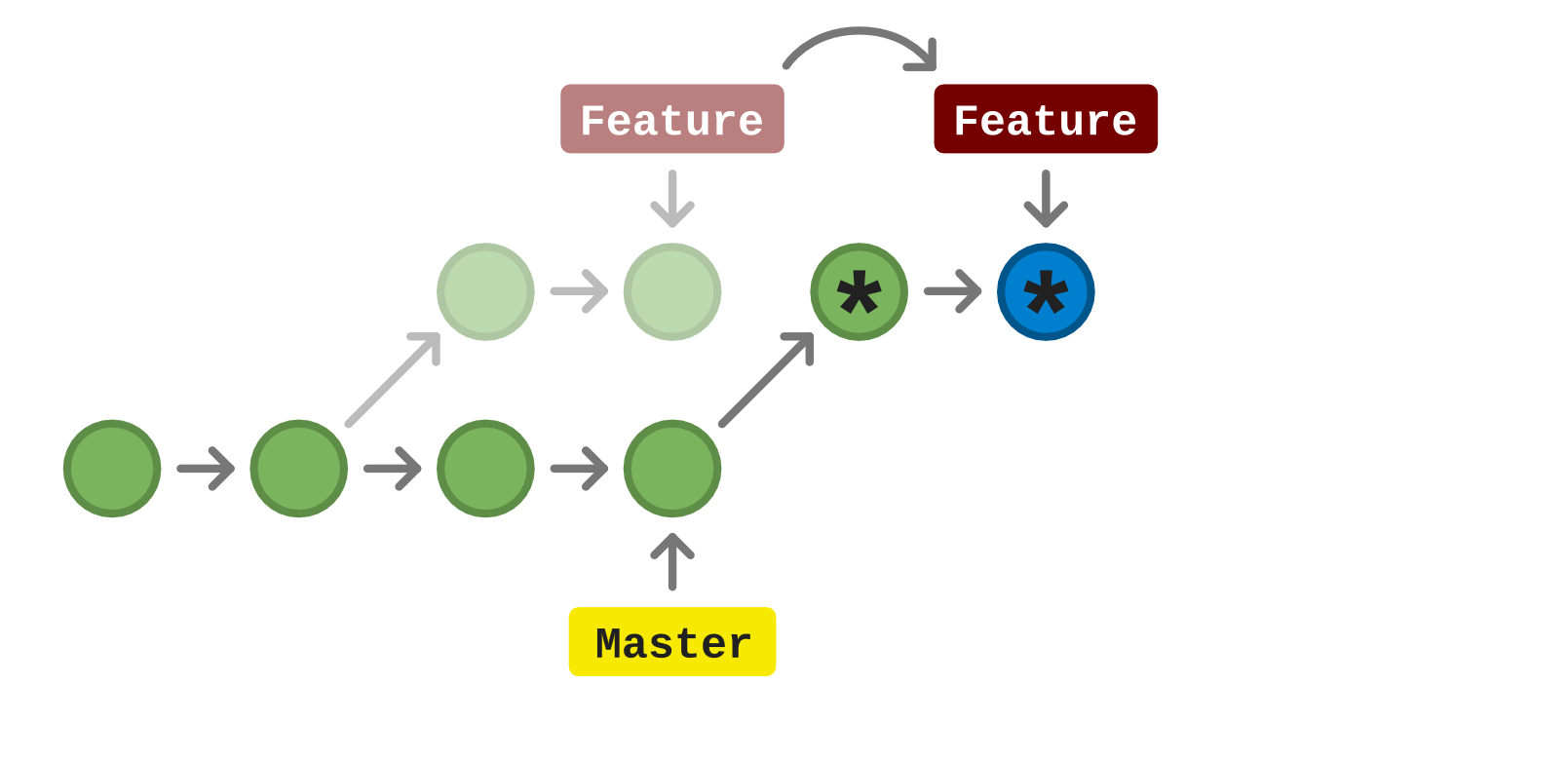
<p class="mb0"><img class="auto" src="https://acko.net/files/sprg/git.png" alt="Git rebase" /></p>

</div>

<div class="g8 i2"><div class="pad">

<h2 class="mt3">Rebase Richard Stallman</h2>

<p>Anyway so, when faced with a stressful and unexpected situation, Stallman freaks&nbsp;out.</p>

<p>Now let's look at the Medium post <a href="https://selamjie.medium.com/remove-richard-stallman-fec6ec210794" target="_blank">Remove Richard Stallman</a> from the last dust&nbsp;up:</p>

<blockquote>
  <p><i>I’m writing this because I’m too angry to&nbsp;work.</i></p>
  <p><i>I’m writing this because at 11AM on Wednesday, September 11th 2019, my friend sent me an email that was sent to an MIT Computer Science and Artificial Intelligence Laboratory (CSAIL) mailing&nbsp;list.</i></p>
  <p><i>This email came from Richard Stallman, a prominent computer&nbsp;scientist.</i></p>
</blockquote>

<p>A single email sent you into a rage, you&nbsp;say?</p>

<blockquote>
<p><i>I was shocked. I continued talking to my friend, a female graduate student in CSAIL, about everything, trying to get the full email thread (I wasn’t on the mailing list). I even started emailing reporters — local and national, news sites, newspapers, radio stations. I couldn’t stop thinking about it. During my 45-minute drive home, when I normally listen to podcasts or music, I just sat in complete&nbsp;silence.</i></p>
</blockquote>

<p>And then you couldn't stop talking about it. You dumped it all on a friend and turned them into your personal backchannel? You reached out to multiple reporters? Your normal routine was completely thrown&nbsp;off?</p>

<blockquote>
<p><i>So I told my friends that I would just write a story myself. I’d planned to do it after work today; instead, because I can’t possibly focus, I’m working on it&nbsp;now.</i></p>

<p><i>The problems are so&nbsp;<b>obvious</b>.</i></p>

<p><i>Why do we wait until it becomes bad and public and unbearable and people like me have to write posts like&nbsp;this?</i></p>

<p><i>Why do we ponder the low enrollment of female and minority graduate students at MIT with one hand and endorse shitty men in science with the other? Not only endorse them — we invite them to our campus where they will brush shoulders with those same female and minority&nbsp;students.</i></p>
</blockquote>

<p>There's a thing that's extremely obvious to her, that she finds unbearable. She is very frustrated that others aren't automatically on board. She hates the idea of being around them and even hints that it is unpleasant to touch&nbsp;them.</p>

<p>She's doing the <em>exact</em> same thing Stallman was on the plane. What's more, she is using all the autistic registers to describe her discomfort: bottled up emotions, OCD, disruption of routine, sensory discomfort, and so&nbsp;on.</p>

<p>It's also similar to my story of being squished around a restaurant table. The big difference is: nobody is forcing her to do anything. This is all just about an email somebody forwarded to her, from a list she's not even&nbsp;on.</p>

<p>What's really, <em>really</em> funny is the next&nbsp;part:</p>

<blockquote>
<p><i>There is nothing I have seen a man in tech do that a woman could not. What’s more, the woman would probably be less egotistical and more team-oriented about&nbsp;it.</i></p>
</blockquote>

<p>Like freaking out in public but pretending you're doing it for the children. Did you know that they say that autism tends to manifest differently in women than in men? And that men tend to have a systems-focus while women tend to have a people-focus? That female autists tend to be more verbally fluent and hence often go unnoticed for years? You say you are an MIT robotics engineer with a fondness for&nbsp;writing?</p>

<blockquote>
<p><i>There is nothing I have seen a woman in tech do that a man could not. What’s more, the man would probably be less egotistical and more team-oriented about&nbsp;it.</i></p>
</blockquote>

<p>Doesn't sound so pleasant anymore, does it? This is the "Women are Wonderful" effect in the wild: making patently sexist statements is okay if they make women sound&nbsp;good.</p>

<blockquote>
<p><i>There is no single person that is so deserving of praise their comments deprecating others should be allowed to slide. Particularly when those comments are excuses about rape, assault, and child sex&nbsp;trafficking.</i></p>
</blockquote>

<p>Notice that the person who openly denigrated <em>"shitty men in science"</em> in bulk earlier claims it is wholly unacceptable to deprecate&nbsp;others, while misrepresenting them as endorsing horrific crimes wholesale.</p>

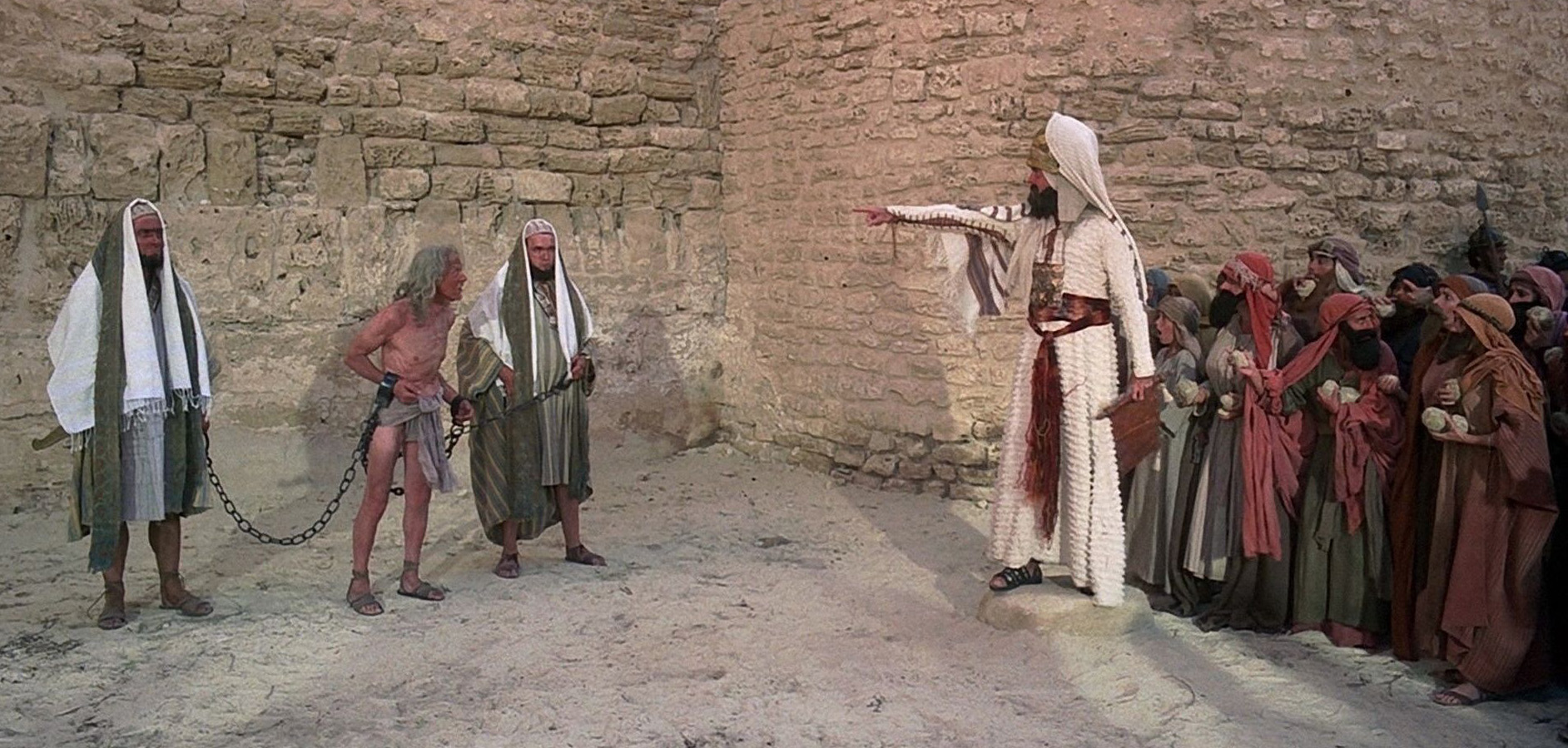
<p>Let the sperg who is a buddha cast the first&nbsp;stone.</p>

</div></div>

<div class="g12 mt0 mb1">

<p class="mb0"><img class="auto" src="https://acko.net/files/sprg/life-of-brian.jpg" alt="Stoning Scene - The Life of Brian" /></p>

</div>

<div class="g8 i2"><div class="pad">
  
<h2 class="mt3">Dogs and Cats</h2>

<p>It's easy to conclude the above represents enormous, total, widespread hypocrisy. But there's a subtle distinction that threatens to get&nbsp;lost.</p>

<p>Stallman was unexpectedly stuck on a plane. I was unexpectedly forced to choose between going hungry or having an extremely uncomfortable&nbsp;dinner.</p>

<p>But nobody was forced to listen to Stallman having a discussion on a private mailing&nbsp;list.</p>

<blockquote>
<p><i>Why do we wait until it becomes bad and public and unbearable and people like me have to write posts like&nbsp;this?</i></p>
</blockquote>

<p>If anyone is being willfully unbearable, it is people who pretend this distinction does not matter. That every knee must bend regardless of who and when and&nbsp;where.</p>

<p>I've thought a lot about what exactly it is that social media is and does. Why it is seemingly so&nbsp;pernicious.</p>

<p>One conclusion is that it is a perfect environment for social predators, especially those with cluster B disorders such as narcissism and borderline. The platforms reward attention-seeking, and thrive on gossip and hearsay. Users trade publicly in reputation rather than facts. The lack of logic in seizing control of an organization when you detest its founders' ideas makes this clear: it's not about the principles, but about grabbing power and&nbsp;funding.</p>

<p>Social media also encourages these behaviors even for those not predisposed to it, simply through monkey-see-monkey-do. The notion of activists as "social script kiddies" is particularly relevant here: people might not realize it, but they are often acting out thinly disguised scripts for emotional abuse, even cult indoctrination. Just fill in the blanks and <a href="https://twitter.com/St_Rev/status/1366682418992799747" target="_blank">let it rip</a>. Worse is that it also forces opponents to adopt a systematic way of countering it: zero tolerance for such shenanigans anywhere, <em>classement verticale</em>, into the trash it&nbsp;goes.</p>

<p>But I think there's something else too, and it ties back to one of the oldest stories in the book: <em>The Boy Who Cried&nbsp;Wolf.</em></p>

<p>The villagers in the story are misled to believe there is an imminent threat. This captures their attention, sending them on a pointless wolf hunt. This happens so often, they conclude there is no danger. When a wolf finally does show up, they don't believe it, and people get&nbsp;eaten.</p>

<p>Social media does something similar, because it creates a global village. But it's not quite the&nbsp;same.</p>

<p>Everyone who subscribes to it is constantly being yelled at that there are wolves everywhere. Many take it seriously, think about it, and join an Anti-Wolf Coalition. Some even go out and hunt. But usually there aren't any real wolves in their neighborhood. So they spend their energy obsessing for no reason. People become afraid to go out at night, worried they might get eaten. Eventually even ordinary accidents are interpreted as wolf attacks. Owning a dog stops being popular, especially if you have&nbsp;children.</p>

<p>Then one day, a leopard shows up. A boy spots the creature at night, but it is difficult to see, so when he describes it, it sounds just like a cat. <em>"Cats are harmless!"</em> the villagers say. <em>"They're nothing like&nbsp;wolves!"</em></p>

<p>And the leopard ate very&nbsp;well.</p>

</div></div>

<div class="c mt4"></div>
]]></content>
  </entry>
  
  <entry>
    <title type="html"><![CDATA[On Witchcraft]]></title>
    <link href="https://acko.net/blog/on-witchcraft/"/>
    <updated>2021-02-10T00:00:00+01:00</updated>
    <id>https://acko.net/blog/on-witchcraft</id>
    <content type="html"><![CDATA[<p><img src="https://acko.net/files/witchcraft/cover.jpg" style="position: absolute; left: -5000px; top: 0;" alt="Cover Image" /></p>

<div class="g8 i2 first"><div class="pad">

<h2 class="sub">Lies, damned lies, and social media</h2>

<p>Rhetoric about the dangers of the internet is at a feverish high. The new buzzword these days is "disinformation." Funnily enough, nobody actually produces it themselves: it's only <em>other</em> people who do so. </p>

<p>Arguably the internet already came up with a better word for it: an "infohazard." This is information that is inherently harmful and destructive to anyone who hears or sees it. Infohazards are said to be profoundly unsettling and, in <a href="http://www.scpwiki.com" target="_blank">horror stories</a>, possibly terminal: a maddening song stuck in your head; a realization so devastating it saps the will to live; a curse that happens to anyone who learns of it. You know, like the videotape from <em>The Ring</em>.</p>

<p>Words of power are nothing new. Neither is the concept of magic: weaving language into spells, blessing or harming specific people, or even compelling the universe itself to obey. Like much human mythology, it's wrong on the surface, but correct in spirit, at least more than is convenient. Luckily most actual infohazards are pretty mundane and individually often harmless, being just dumb memes. The problem is when magical thinking becomes the norm and forms a self-reinforcing system.</p>

<p>This is a weird place to start for sure, but I think it's a useful one. Because that is the concern, right, that people are being <em>bewitched</em> by the internet?</p>


</div></div>

<div class="g10 i1 mt1 mb1">

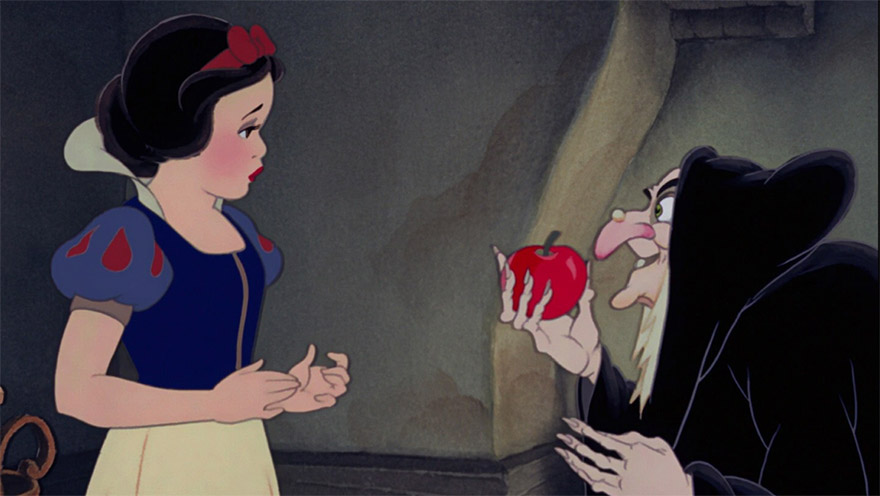
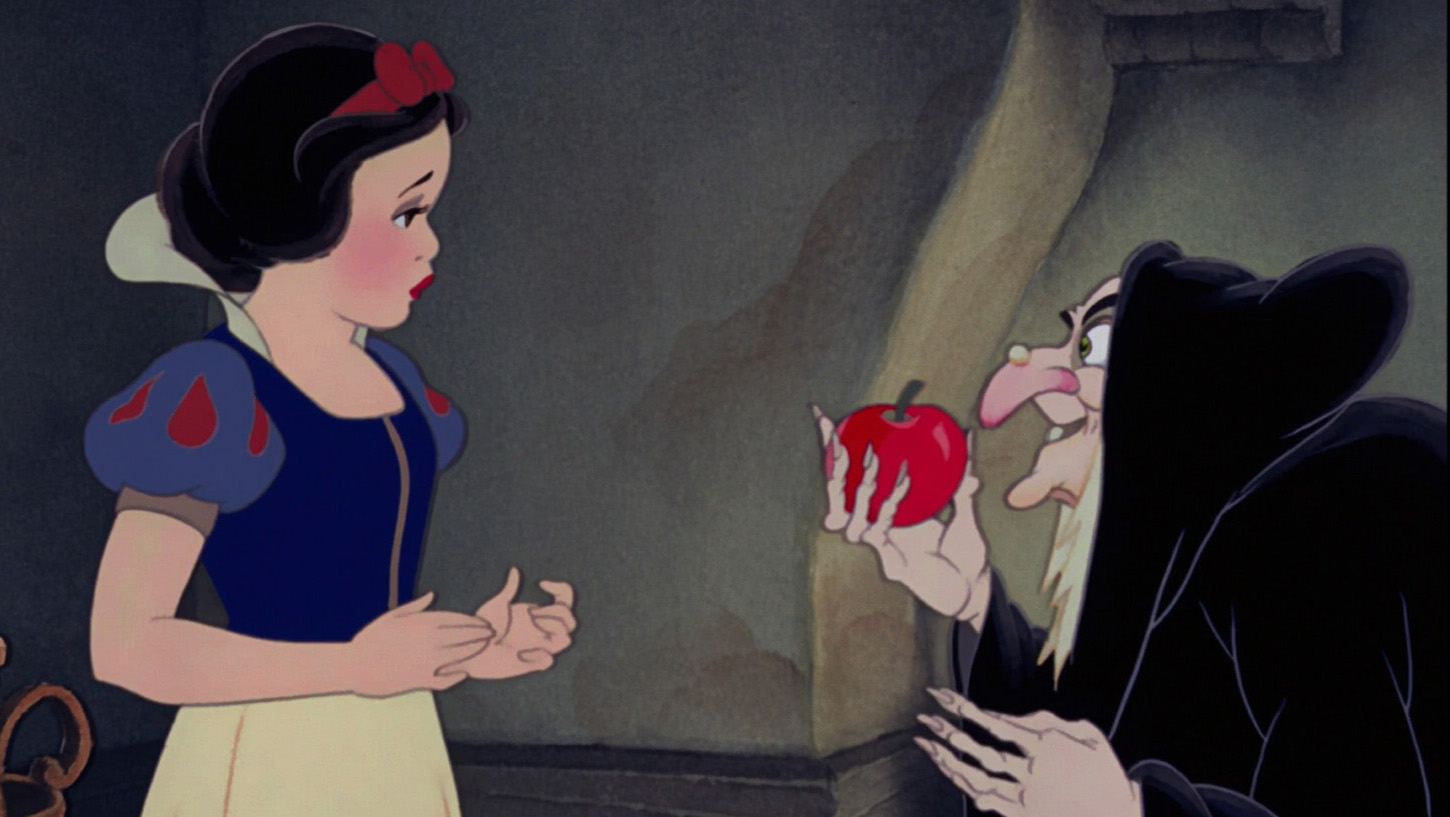
<p class="mb0"><img class="auto" src="https://acko.net/files/witchcraft/cover-lg.jpg" alt="A witch offering a poison apple" /></p>

</div>

<div class="g8 i2"><div class="pad">

<h2>I.</h2>

<p>Last year the following was <a href="https://www.wsj.com/articles/facebook-knows-it-encourages-division-top-executives-nixed-solutions-11590507499" target="_blank">making the rounds</a>, about polarization and extremism on Facebook, and their efforts to curb it. Citing work by Facebook researcher and sociologist Monica Lee:</p>

<blockquote><p><em>The high number of extremist groups was concerning, the presentation says. Worse was Facebook’s realization that its algorithms were responsible for their growth. The 2016 presentation states that “64% of all extremist group joins are due to our recommendation tools” and that most of the activity came from the platform’s “Groups You Should Join” and “Discover” algorithms: “Our recommendation systems grow the&nbsp;problem.”</em></p></blockquote>

<p>It's an extremely tweetable stat and quote, so naturally they first tell you how to feel about it. The article is rather long and dry, so we all know many people who shared it didn't read it in full. The current headline says that Facebook <em>"shut down efforts to make the site less divisive."</em> If you look at the URL, you can see it was originally titled: <em>"Facebook knows it encourages division, top executives nixed solutions."</em> So pot, meet kettle, but that's an aside.</p>

<p>While they acknowledge that some people believe social media has little to do with it, they immediately drown out the entire notion by referencing the American election and never mention this viewpoint again.</p>

<p>Don't get me wrong, I do think Facebook has problems, which is why I'm not on it. Optimizing mainly for time spent on the site is a textbook case of <a href="https://en.wikipedia.org/wiki/Goodhart%27s_law" target="_blank">Goodhart's law</a>: it's no surprise that it goes wrong. But a) that's not even a big-tech-specific problem and b) that's not what most people actually want changed when they cite this. What they say is that Facebook needs to limit "harmful content": they don't want Facebook to interfere less, they want it to interfere more.</p>

<p>This is in fact a very common pattern in all "disinformation" discourse: they tell you that what you are seeing is <em>specifically</em> abnormal and/or harmful, without any basis to actually justify limiting the conclusion. Like that anything about this is Facebook-specific. It's just that it's an easier sell to pressure one platform or channel at a time. It's not about what, but about who and whom.</p>

<p>There's also an assumption being snuck in. If a recommendation algorithm suggests you join a group, does the operator of that algorithm have a moral responsibility for your subsequent actions? If you agree with this, it seems Facebook should <em>never</em> recommend you join an extremist group, because extremism is bad. That sounds admirable, but is also not very achievable. It also hinges on what exactly is and isn't extreme, which is highly subjective.</p>

<p>Harmful content is for example <em>"racist, conspiracy-minded and pro-Russian."</em> So I doubt that they would consider e.g. the Jussie Smollett hoax or the hunt for the Covington Kid as harmful, seeing as they were sanctioned by both media outlets and prominent politicians. Despite being textbook cases of mass hysteria.</p>

<p>Calls for racially motivated action which result in violence, arson and anarchy under the Black Lives Matter flag also do not seem to count in practice. Facebook in fact placed BLM banners on official projects for most of 2020, as did others. The people who say we need to be deprogrammed seem to be doing most of the actual activism in the first place.</p>

</div></div>

<div class="g10 i1 mt0 mb1">

<p class="mb0"><img class="auto" src="https://acko.net/files/witchcraft/react-blm.png" alt="Facebook's React urging people to donate to Black Lives Matter" /></p>
<p class="mb0 tc"><em>Facebook using its open-source projects to urge people to donate to political causes in an election year.</em></p>

</div>

<div class="g8 i2"><div class="pad">
  
<p>Like most big social media companies, Facebook's claims of political impartiality ring hollow on both an American and international level. Plus, if you actually read the whole article, the take-away is that they have put an inordinate amount of time, effort and process into this issue. They're just not very good at it.</p>

<p>But it doesn't really matter because in practice, people will share one number, with no actual comparison or context, from a source we can't see ourselves. This serves to convince you to let a specific group of people have specific powers with extremely wide reach, with no end in sight, for the good of all.</p>

<p>Infohazard.</p>


<h2 class="mt3">II.</h2>

<p>It's worth to ponder the stat. What <em>should</em> the number be?</p>

<p>First, some control. If 64% of members of extremist groups joined due to a machine recommendation, then what is that number for non-extremist groups? It would be useful to have <em>some</em> kind of reference. It would also be useful to compare to other platforms, to know whether Facebook is particularly different here. This is not rocket&nbsp;science.</p>

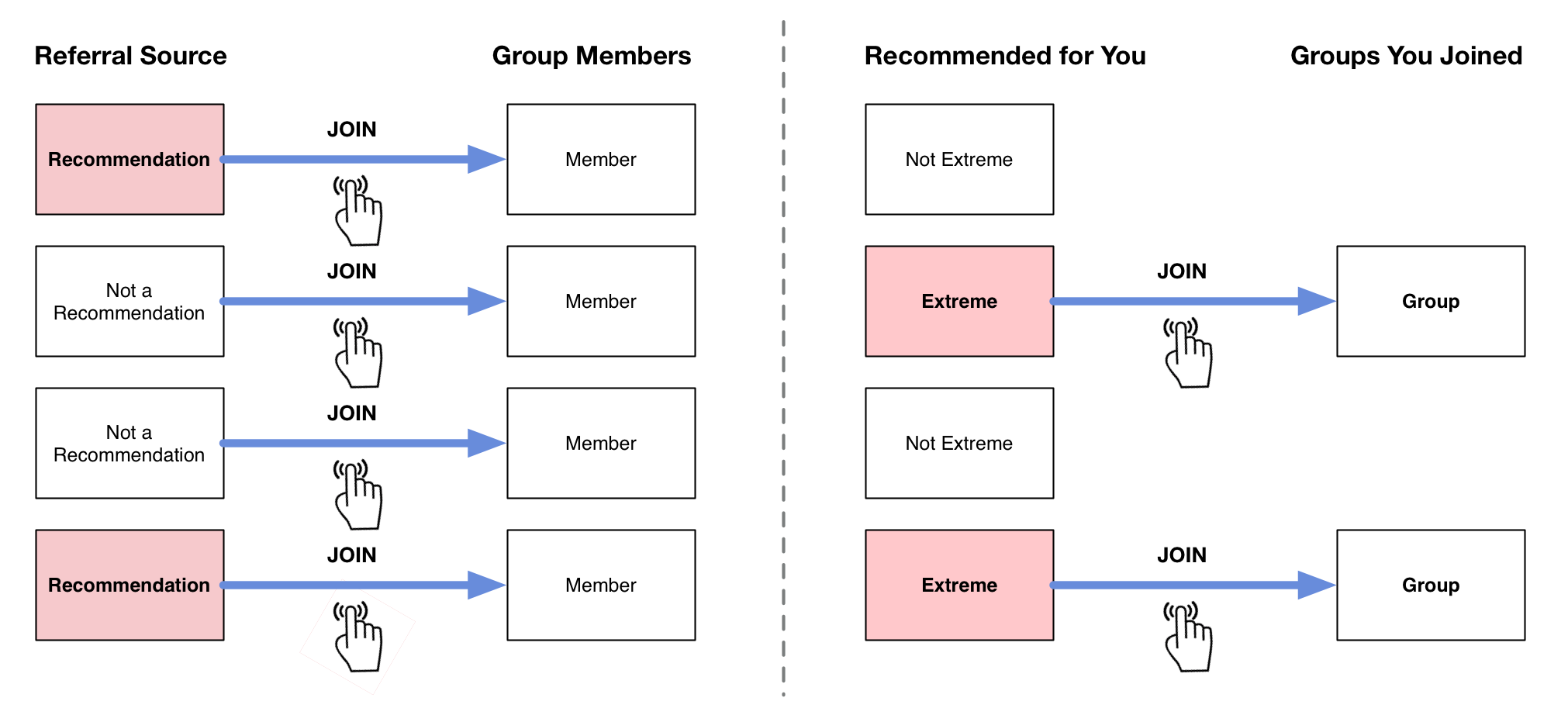
<p>Second, you should be sure about what this number is specifically measuring. It only tracks how effective recommendations are <em>relative to other Facebook methods of discovering extremist groups</em>, like search or likes. This is very different from <em>which recommended groups people actually join</em>. Confusing the two is how the trick works.</p>

</div></div>

<div class="g10 i1 mt0 mb1">

<p class="mb0"><a href="https://acko.net/files/witchcraft/bayes.png" target="_blank"><img class="auto" src="https://acko.net/files/witchcraft/bayes.png" alt="The two different conditional probabilities" /></a></p>
<p class="mb0 tc"><em>The difference between <code>P(Recommended&nbsp;|&nbsp;(Joined&nbsp;&amp;&nbsp;Extremist))</code> and <code>P((Joined&nbsp;&amp;&nbsp;Extremist)&nbsp;|&nbsp;Recommended)</code>.</em></p>

</div>

<div class="g8 i2"><div class="pad">
  
<p>They're talking about the thing on the left, not on the right.</p>

<p>If ~0% of group joins were due to a recommendation, that would mean the recommendation algorithm is so bad nobody uses it. It's always wrong about who is interested in something. You wouldn't even see this if e.g. right-wing extremism was being shown only to left-wing extremists, or vice versa, because both camps pay enormous attention to each other. You would basically only need to recommend extremist groups to 100% apolitical people. Ironically, people would interpret that as the worst possible radicalization machine.</p>

<p>They do say Facebook had the idea of <em>"[tweaking] recommendation algorithms to suggest a wider range of Facebook groups than people would ordinarily encounter,"</em> but seem to ignore that this implies exposing the middle to more of the extremes.</p>

<p>If ~100% of group joins were due to a recommendation, then that would imply the algorithm is so overwhelmingly good that it eclipses all other forms of discovery on the site, at least for extremist groups. Hence it could only be recommending them to people who are extremists or definitely want to hang out with them. This would be based on a person's strong prior interests, so the algorithm wouldn't be causing extremism either.</p>

<p>The value of <em>this</em> number doesn't really matter. The higher it is, the worse it sounds on paper: the recommendation engine seems to be doing more of the driving, even though the absolute numbers likely shrink. But the lower it is, the less relevant the recommendations must be, creating more complaints about them. It's somewhere in the middle, so nobody can actually say.</p>

<p>The <em>popularity</em> of extremist groups has nothing to do with <em>what percentage</em> of their members join <em>due to a recommendation</em>. You need to know the other stats: how often are certain recommendations made, and actually acted upon? How does it differ from topic to topic? If a particular category of recommendations is removed, do people seek it out in other ways?</p>

<p>The only acceptable value, per the censors, is if it becomes ~0% <em>because</em> Facebook stops recommending extremist groups altogether. That's why this really is just a very fancy call for censorship, using a lone statistic to create a sense of moral urgency. If a person had a choice of extremist and non-extremist recommendations, but deliberately chose the more extreme one... wouldn't that make a pretty strong case that the algorithm explicitly <em>isn't responsible</em> and actually just a scapegoat?</p>

<p>The article tells us that <em>"[divisive] groups were disproportionately influenced by a subset of hyperactive users,"</em> so it seems to me that personal recommendations have a much higher success rate than machine recommendations. In that case, your problem isn't an algorithm, it's that everyone and their dog has a stake in manipulating this, and they do. They even brag about it in <a href="https://time.com/5936036/secret-2020-election-campaign/" target="_blank">Time magazine</a>.</p>

<p>There's a question early on in the article: <em>"Does its platform aggravate polarization and tribal behavior? The answer it found, in some cases, was yes."</em> Another way of putting that is: "The answer in most cases was no."</p>


<h2 class="mt3">III.</h2>

<p>The notion that groups are dominated by hyperactive influencers does track with my experience. I once worked in social media advertising, and let me tell you the open industry secret: going viral is a lie.</p>

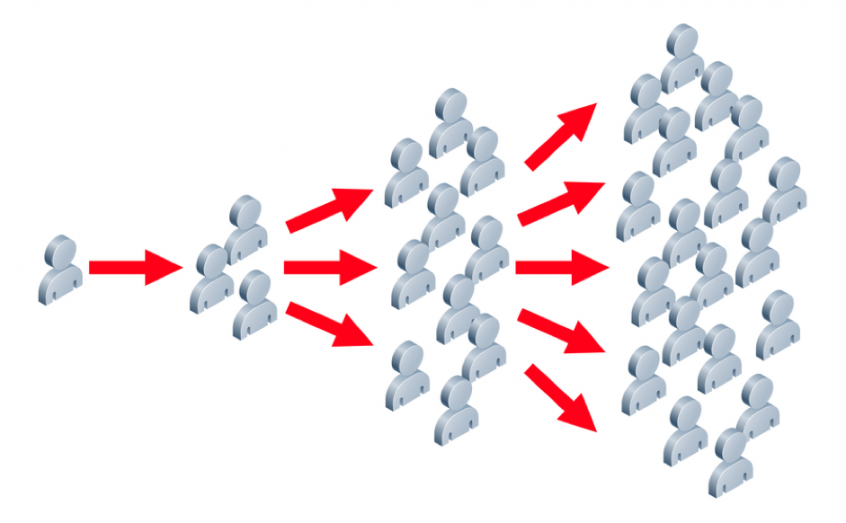
<p>The romantic idea is that some undiscovered Justin Bieber-like wunderkind posts something brilliant online, in a little unknown corner. A kind soul discovers it, and it starts being shared from person to person. It's a bottom-up grass-roots phenomenon, growing in magnitude, measured by the virality coefficient: just like COVID if it's &gt;1 then it spreads exponentially. This is the sort of thing mediocre marketing firms will explain to you with various diagrams.</p>

<p class="tc mt2 mb2"><img src="https://acko.net/files/witchcraft/viral.png" alt="Going viral from one person to many" class="auto" style="width: 80%" /></p>

<p>The reality is very different. Bottom-up virality near 1 is almost unheard of, because that would imply that <em>every person</em> who sees it also shares it with someone else. We just don't do this. For something to go viral, it must be broadcast to a <em>large enough group</em> each time, so that at least one person decides to repost it to another big&nbsp;group.</p>

<p>Thus, going viral is not about bottom-up sharing at all: it's about content riding the top-down lightning between broadcasters and audiences. These channels build up their audiences glacially by comparison, one person at a time. One pebble does not shift the landscape. It also means the type of content that can go viral is constrained by the existing network. Even group chats work this way: you have to be invited in&nbsp;first.</p>

<p>This should break any illusions of the internet as a flat open space: rather it is accumulated infrastructure to route attention. Everyone knows you need sufficient eyeballs to be able to sell ad space, but somehow, translated into the world of social media, this basic insight was lost. When the billboard is a person or a personality, people forget. Because they seem so accessible.</p>

<p>In the conflict between big tech and old media, you often hear the lament that <em>"tech people don't like to think about the moral implications of what they build."</em> My pithy answer to that is <em>"we learned it from you"</em> but a more accurate answer is "yes, we do actually, quite a lot, and our code doesn't even have bylines." Though I can't actually consider myself "big tech" in any meaningful way. In this house we hack.</p>

<p>I can agree that large parts of social media are basically just cesspits of astroturfing and mass-hypnosis. But once you factor in who is broadcasting what to whom, and at what scale, the lines of causation look very different from the usually cited suspects.</p>

<p>While there are indeed weird niche groups online and offline, it is the crazy non-niche groups we should be more concerned about. Who is shouting the loudest, to the most people? Why, the traditional news outlets. The ones that 2020 revealed to be far less capable, objective and in-the-know than they pretend to be. The ones who chastised public gatherings as irresponsible only when it was the wrong group of people doing so.</p>

<p>So don't just question what they say and how they say it. Ask yourself what other stories they could've written, and why they did not.</p>


<h2 class="mt3">IV.</h2>

<p>What's especially frustrating is that the class of people who are supposed to be experts on media and communication have themselves been bubbled inside dogmatic social sciences and their media outposts. If you ask these people to tell you about radicalization on the internet, you are likely to hear a very detailed, incomplete, mostly wrong summary of pertinent events.</p>

<p>Much of this can be attributed to what I mentioned earlier: telling you how to feel about something before they tell you the details. Sometimes this is done explicitly, but often this is done by way of Russell Conjugation: "I am being targeted, you are getting pushback, they are being held accountable." The phrasing tells you whether something is happening to a person you should root for, be neutral about, or dislike. Given a pre-existing framework of oppressors and oppressed, they just snap to grid, and repetition does the rest.</p>

<p>Sometimes it's blatant, like when the NYT rewrote a fairly neutral article about Ellen Pao into <a href="http://newsdiffs.org/diff/934341/934454/www.nytimes.com/2015/07/11/technology/ellen-pao-reddit-chief-executive-resignation.html" target="_blank">nakedly partisan hero worship</a> a few years ago.</p>

<p>But most people don't even realize they're doing it. When called upon they will insist <em>"it's totally different,"</em> even if it's not. It's judging things by their subjective implications, not by what they objectively are. Once the initial impression of the players is set, future events are shoehorned to fit. The charge of <em>whataboutism</em> is a convenient excuse to not have to think about it. This is how you end up with people sincerely believing Jordan Peterson is an evil transphobe rather than a compelled speech objector dragged through the mud.</p>

<p>Information that disproves the narrative is swept under the rug, with plenty of scare quotes so you don't go check. If a reporter embarrasses themselves by asking incessantly leading questions, the story will shift to how <a href="https://www.independent.co.uk/voices/cathy-newman-abuse-channel-4-jordan-peterson-metoo-backlash-latest-a8170031.html" target="_blank">mean and negative the response is</a>, instead of actually correcting the misconceptions they just tried to dupe an entire nation with.</p>

<p>The magnitude of a particular event is also not decided by how many people participated in it, but rather, by how many people heard about it. This is epitomized by the story format that <em>"the X community is mad about Y"</em> based on 4 angry tweets or screencaps. It wasn't a thing until they decided to make it a thing, and now it is definitely a thing.</p>

<p>The idea of the media as an active actor in this process is a concept they are quite resistant to. Because if it isn't a story until they write the story, that means they are not actually reporting broadly on what's happening. They're just the same as anyone&nbsp;else.</p>

</div></div>

<div class="g6 mb1">

<a href="https://www.theguardian.com/media/2018/sep/18/report-youtubes-alternative-influence-network-breeds-rightwing-radicalisation" target="_blank">
  <img class="mt1" src="https://acko.net/files/witchcraft/influence-network.png" alt="The alternative influence network on youtube - Data &amp; Society" />
</a>

</div>

<div class="g6"><div class="pad">

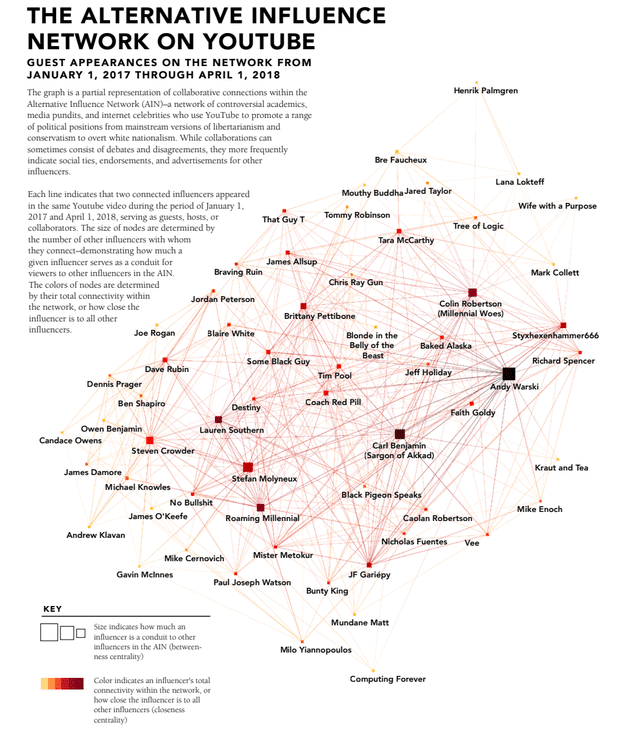
<p>Part of the problem is that what passes for news about the internet is mostly just gossip. Even if it is done in good faith, it is very hard for an individual to effectively see the full extent of an online phenomenon. In practice they rarely try, and when they do, the data gathering and analysis is usually amateur at best, lacking any reasonable control or perspective.</p>

<p>You will often be shown a sinister looking network graph, proving how corrupting influences are spreading around. What they don't tell you is that this is what the entire internet looks like everywhere, and e.g. a knitting community likely looks exactly the same as an alt-right influencer network. Each graph is just a particular subset of a larger thing, and you have to think about what's <em>not shown</em> as well as what is.</p>

<p>It's an even more profound mistake to think that we can all agree on which links should be cut and which should be amplified. Just because we can observe it, doesn't mean we know how to improve it. In fact, the biggest problem here is that so few people can decide what so many can't see. That's what makes them want to fight over it.</p>

</div></div>

<div class="g8 i2"><div class="pad">

<p class="mt3">The idea that any of this is achievable in a moral way is itself a big red flag: it requires you to be sufficiently bubbled inside one ideology to even consider doing so. It is fundamentally illiberal.</p>

<p>It really is quite stunning. By and large, today the people who shout the loudest about disinformation, and the need to correct it, are themselves living in an enormous house of cards. It is built on bad thinking, distorted facts and sometimes, straight up gaslighting. They have forced themselves on companies, schools and governments, using critical theory to beat others into submission. They use the threat of cancellation as the stick, amplified eagerly by clickbait farms... but it's Facebook's fault. "<em>They</em> need to be held accountable."</p>

<p>These advocates only know how to mouth other people's incantations, they don't actually live by them.</p>

<p>Here's the thing about secret police: <a href="https://onlinelibrary.wiley.com/doi/10.1111/ajps.12475" target="_blank">when studied</a>, it is found that it's mostly underachievers who get the job and stick with it. Because they know that in a more merit-driven system, they would be lower on the totem pole.</p>

<p>If the world is messed up, it's because we gave power to people who don't know wtf they're supposed to do with it.</p>

</div></div>

<div class="c mt4"></div>
]]></content>
  </entry>
  
  <entry>
    <title type="html"><![CDATA[A Useful BitTorrent Analogy]]></title>
    <link href="https://acko.net/blog/a-useful-bittorrent-analogy/"/>
    <updated>2012-02-05T00:00:00+01:00</updated>
    <id>https://acko.net/blog/a-useful-bittorrent-analogy</id>
    <content type="html"><![CDATA[<div class="c"></div>

<aside class="g5">
  <p class="tc">
    <img style="top: 0" src="/files/bittorrent/xerox.jpg" alt="Xerox 914 copier" />
    The first successful commercial photo copier, the&nbsp;<a href="https://secure.wikimedia.org/wikipedia/en/wiki/Xerox_914">Xerox 914</a>.
  </p>

</aside>

<div class="g7 first"><div class="pad">

<p>
BitTorrent has been around for over a decade now. And yet, when mentioned in the media, it's pretty much universally associated with piracy and illegal file sharing.</p>

<p>Just the other day, I saw a journalist write proudly: <em>"No, I don't have a Torrent program and I'm not downloading one."</em> A journalist! Someone who is supposed to be an expert at retrieving information and sharing it!</p>

<p>BitTorrent is not scary, and more so it actually generates the majority of traffic on the internet. In the 21st century it should be a tool that sits on your digital utility belt, not something you wouldn't touch with a 10 foot pole. So here's a simple analogy to help understand it.</p>

</div></div>

<div class="g8 i2"><div class="pad">

<p class="tc m0 orn">· • ·</p>

<p>Imagine a budget-starved teacher needs to hand out notes for class, but can only afford one copy. The document is 10 pages long, and there are 10 students who each need a complete copy.</p>

<p>The teacher could just give the notes to one student, and ask him to make all the copies, but that would only shift the burden, leaving him to pay for all 100 pages.</p>

<p>Instead, the teacher has an idea. She hands page 1 to student #1, page 2 to student #2, and so on, and tells each student to make 10 copies of their single page. The next week, the students can distribute them amongst themselves before class, and everyone gets a complete set. Nobody has to pay for more than their own 10 pages.</p>

<p>Everyone's happy: the teacher gets to share her knowledge cheaply, and the students don't mind paying for their own copies.</p>

<p>In the middle of the term, a new student joins. She could borrow someone else's big pile of notes, and copy the entire stack of paper, but that would mean she would have to pay for it all, and she's on a budget too.</p>

<p>So instead, she just goes around and asks each student to make a single copy of the pages they were assigned previously. The next week, she collects all the pages, and assembles a complete copy without even bothering the teacher.</p>

<p>She gets a free pass to catch up with the class, but the other students don't mind chipping in. That's because she immediately joins the game and can make copies too. The teacher can now hand out one page extra each week, or decide to give one student a free pass. If more students join, it works better and better.</p>

<p>Now instead, imagine that students join and leave the class every single day, and the teacher isn't quite so organized. She just puts her big stack of notes on the desk, and tells everyone they can take any page they want, as long as they promise to immediately make copies for anyone who asks. The students are all friendly, and make sure to keep each other in the loop about which pages everyone has. Both the originals and the copies are copied as many times as needed.</p>

<p class="tc orn">· • ·</p>

<p>That's BitTorrent in a nutshell. For any given class—i.e. a <em>file</em> that people are interested in—a cloud of students forms—i.e. the <em>peers</em> in the so called peer-to-peer network. The peers compare notes, see which pieces they are missing, and swap copies with each other. Eventually, the teacher (a.k.a. the <em>seeder</em>) can leave, taking her original copy with her, and the system will keep working. As long as there is at least one copy of every page in the room, the students can make more, and the document as a whole will live on.</p>

<p>This is pretty much the only way you can effectively distribute a massive archive of sensitive data to thousands or millions of people, without incurring massive bills. You can't use free or ad-supported services, as the material would get taken down instantly due to its sensitive nature. And you can't host it directly, as that would leave a trail pointing back to you.</p>

<p>With BitTorrent, your initial group of 'students' can be sworn to secrecy. After the initial round of copying, the teacher sneaks out, and the students just pin a notice on the bulletin board: "We have copies of <em>The Forbidden Secrets</em> by Dr. X. Come see us." Nobody claims to know who Dr. X is. Ideas and information flow freely, without censorship.</p>

</div></div>
]]></content>
  </entry>
  
</feed>